
There’s no denying that AI has become a pretty big part of many people’s lives. But what started as a handy tool for answering questions and saving us a bit of time has evolved into something much more personal. From crafting a birthday card message to navigating what to say during a tricky argument, AI chatbots are finding their way into some of the more personal parts of our lives.
This got us thinking… who are Brits most likely to swap for a chatbot when they need advice or support? Do men and women use AI differently when it comes to advice? And are some cities more readily embracing AI than others?
To find out, we surveyed over 500 Brits to uncover just how much AI is influencing the ways we communicate and connect with each other. And while the results show that people are turning to chatbots for some surprisingly personal things, it looks like they’re not quite ready to swap their mates for robots… just yet.
What are Brits actually using AI for?
Before we dive into the nitty-gritty of it, what do Brits usually turn to AI for? Almost a quarter (24%) use AI to write work emails or respond to professional messages, while 22% turn to AI when they’re looking for health and wellness advice.
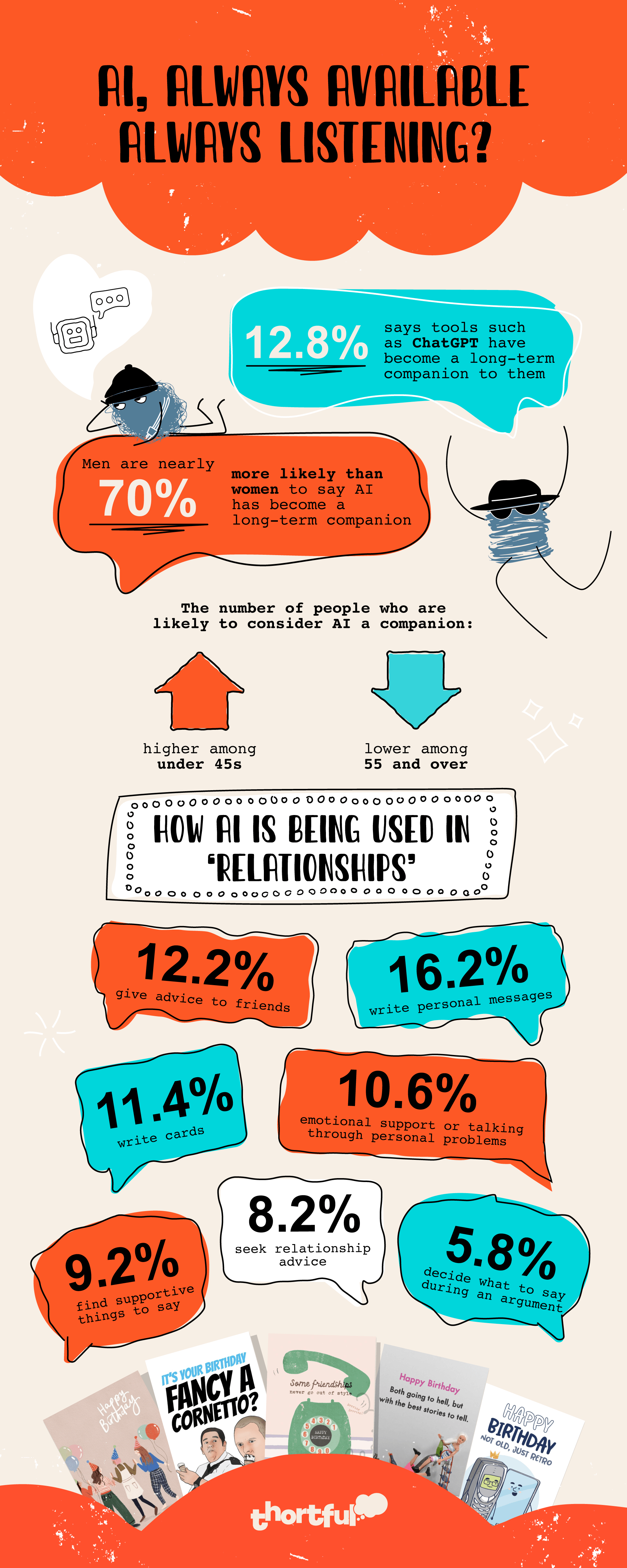
But things start to get a little bit more personal further down the list, with 16.2% using AI to help them write messages, while 11.4% use it to write cards. What’s more, 12.2% turn to AI when they’re looking to give advice to family and friends, while 10.6% rely on AI for emotional support of their own (with 8.2% using it for relationship advice).
AI over your bestie?
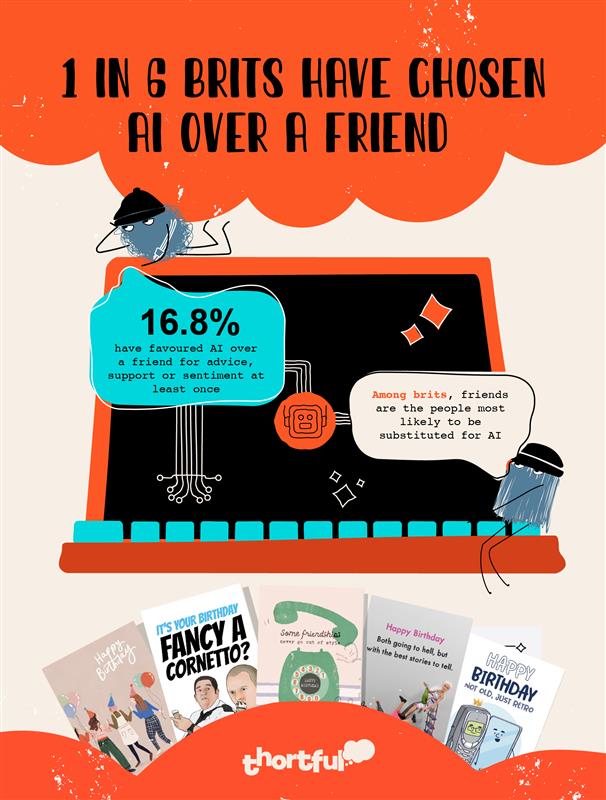
It turns out that some friends might have a little more competition than they realise, with 16.8% of Brits saying they’ve favoured AI over a pal for advice at least once in their life. This is an interesting finding, especially as friends are usually the first people we turn to when we need to vent.
So, what’s going on here? For starters, AI is always there, meaning you don’t have to wait for a friend to finish work or find time for a phone call at 3am when you need to rant.
There’s also something to be said for taking judgment out of the equation. Talking through a problem with a chatbot might feel easier if you’re embarrassed about something or simply don’t want to burden a friend with your problems.
Who are we choosing AI over?
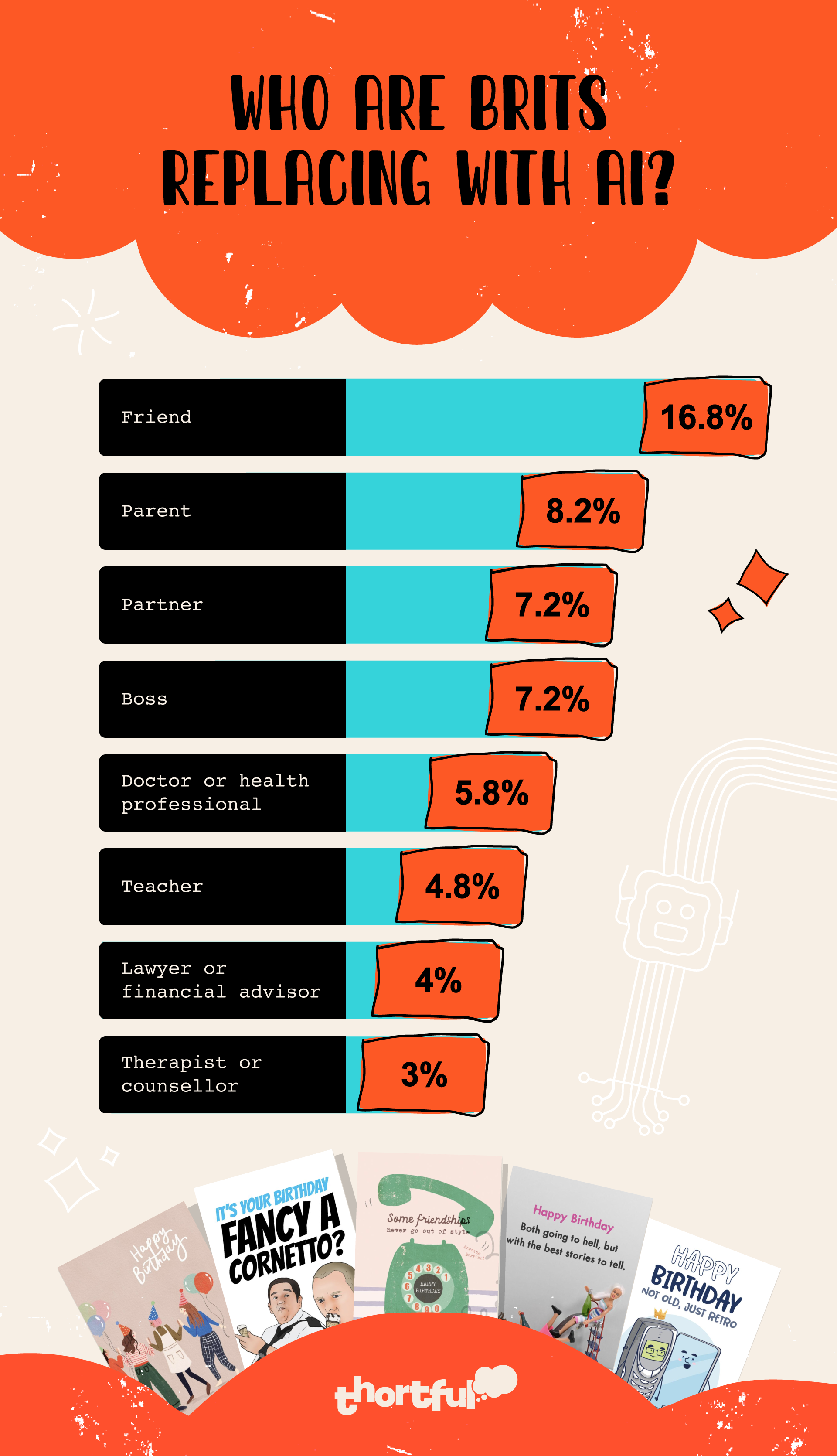
Friends take the top spot when it comes to choosing AI over someone else for advice and support, followed by parents at 8.2% and partners at 7.2%. After that, the percentages get a little smaller:
- Doctors (5.8%)
- Teachers (4.8%)
- Lawyers (4.0%)
- Therapist or counsellor (3.0%)
So, while we might be happy to momentarily swap out our pal for an AI best friend, when it comes to the really important stuff, people are less likely to turn to AI for help.
UK’s quiet love affair?
There’s another interesting side to the story when it comes to AI and our relationships. It’s one thing to ask a chatbot for advice, but are some people starting to see it as more than just a helpful tool?
Overall, 12.8% of those we surveyed said that tools like ChatGPT have become a long-term companion to them. Interestingly, this figure is higher among men than women, with 16.4% of men describing AI as a companion, compared to just 9.7% of women.
On the other hand, we found that women are more likely to value AI for the practical side of its advice, (25.3% vs 12.5% of men).
Britain’s most AI-attached cities
It looks like where you live could also play a part in how you use AI. We found that Edinburgh, Southampton and Manchester had the highest number of respondents describing tools like ChatGPT as a long-term companion, with around 1 in 5 respondents saying they see AI in this way.
Meanwhile, cities like Birmingham, Glasgow and London had the highest number of respondents actively choosing AI over asking a friend or family member for advice. So, while some cities are more open to using AI as a companion, others are more likely to turn to it when they’re in need of a little pep talk.
What do the experts have to say?
Is turning to AI for these things a worrying trend? Not necessarily, says Sim Shamu, Behaviour Specialist and UKSBA Practising Registrant at PBS ABA UK:
“I don’t think turning to AI before another person is automatically a cause for concern. For me, the important thing is what the tool is doing for you. I’ve seen people use AI to explore different ways of wording something they find difficult to say, or to make sense of why they may be feeling anxious before a conversation. Used like that, it can act almost like rehearsal – helping someone organise their thoughts, understand a concept and then going back into the real interaction better prepared.”
Shamu goes on to say: “The habit becomes worth examining when it starts affecting quality of life – when somebody feels less able to have a conversation, make a decision, tolerate uncertainty or maintain a relationship without first relying on AI. I don’t think though that we need to be avoiding AI. Instead, we should be asking whether the tool is helping us participate more effectively in our relationships or gradually replacing parts of those relationships.”
So, are humans being replaced?
Thankfully, it doesn’t look like it. While AI is becoming a popular source of advice for many, most people still aren’t ready to hand over their own judgement. Almost half (46.9%) of those we surveyed said they preferred their own words and ideas, while 13.2% felt AI-generated talking points lacked the all-important human element.
Human thought and connection still come out on top, whether that means listening to your sibling’s rant or filling a card with funny ramblings and memories. An AI chatbot might be able to help you find the right words sometimes, but it can’t write about that one time you and your best friend… well, you just had to be there.
If you’re keen to use your own words in a card but you’re not sure where to begin, our what to write guides are a brilliant place to start. Filled with lots of inspiration, you’ll find hundreds of starters to spark your imagination, including what to write in a birthday card, work anniversary wishes, and much, much more!
And if you’re looking for more fun insights like this, it’s the thortful blog you’ll want to check out.